
A failed sealant joint on a bridge or building doesn't just look bad — it lets water in.
Looking for construction joint sealants but worried about products that crack within one season, lose adhesion in Indian summers, and suppliers who can't even explain the difference between polysulphide and PU?
And water inside a structure is a ticking time bomb.
- 41 years in waterproofing & sealing
- ISO 9001:2015 certified
- Immediate dispatch from ready stock
Get Expert Joint Sealant Recommendation for Your Project
Our sealant specialist will recommend the right chemistry, share the TDS, and dispatch a sample from ready stock.
What happens when a joint sealant fails
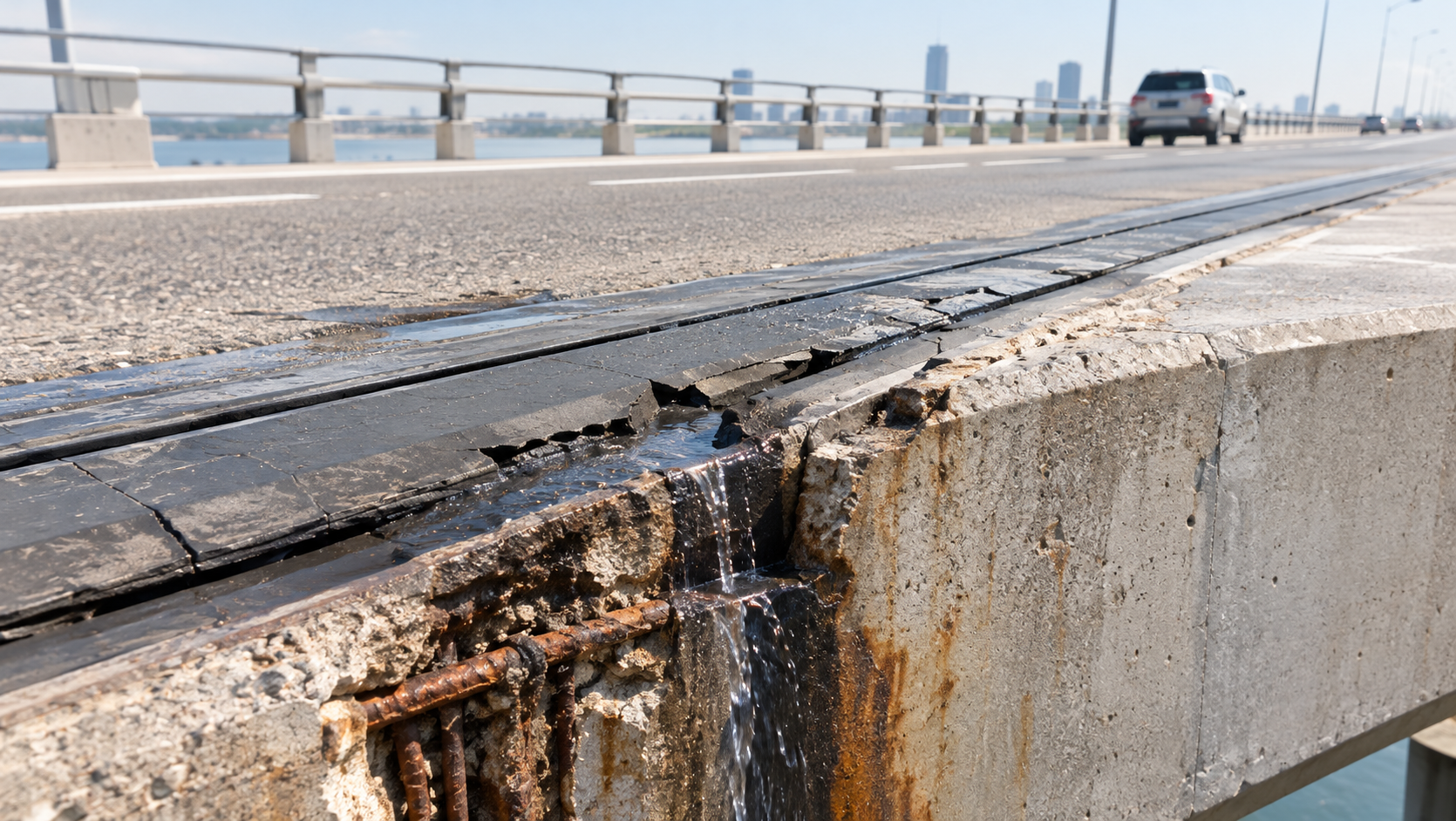
On a bridge
- Water enters the expansion joint.
- It reaches the rebar in the deck slab.
- Corrosion starts — invisible from the surface.
- Two years laterThe concrete is spalling, the structural engineer writes a distress report, and the repair cost is ₹8–15 lakh per joint.
On a highway bridge with 20–30 joints? That's ₹2–4 crore in remedial work — on a sealant that should have cost ₹50,000 per joint to install correctly the first time.

On a building
- Water seeps through expansion joints between wings or around window frames.
- First monsoonFlat owners see damp patches within the first monsoon.
- Year twoPaint is peeling, plaster crumbling, and your defect liability phone ringing non-stop.
Re-sealing on a completed building means scaffolding (₹2–5 lakh), surface prep, and reapplication — 5 to 10x the original cost. Plus reputational damage.
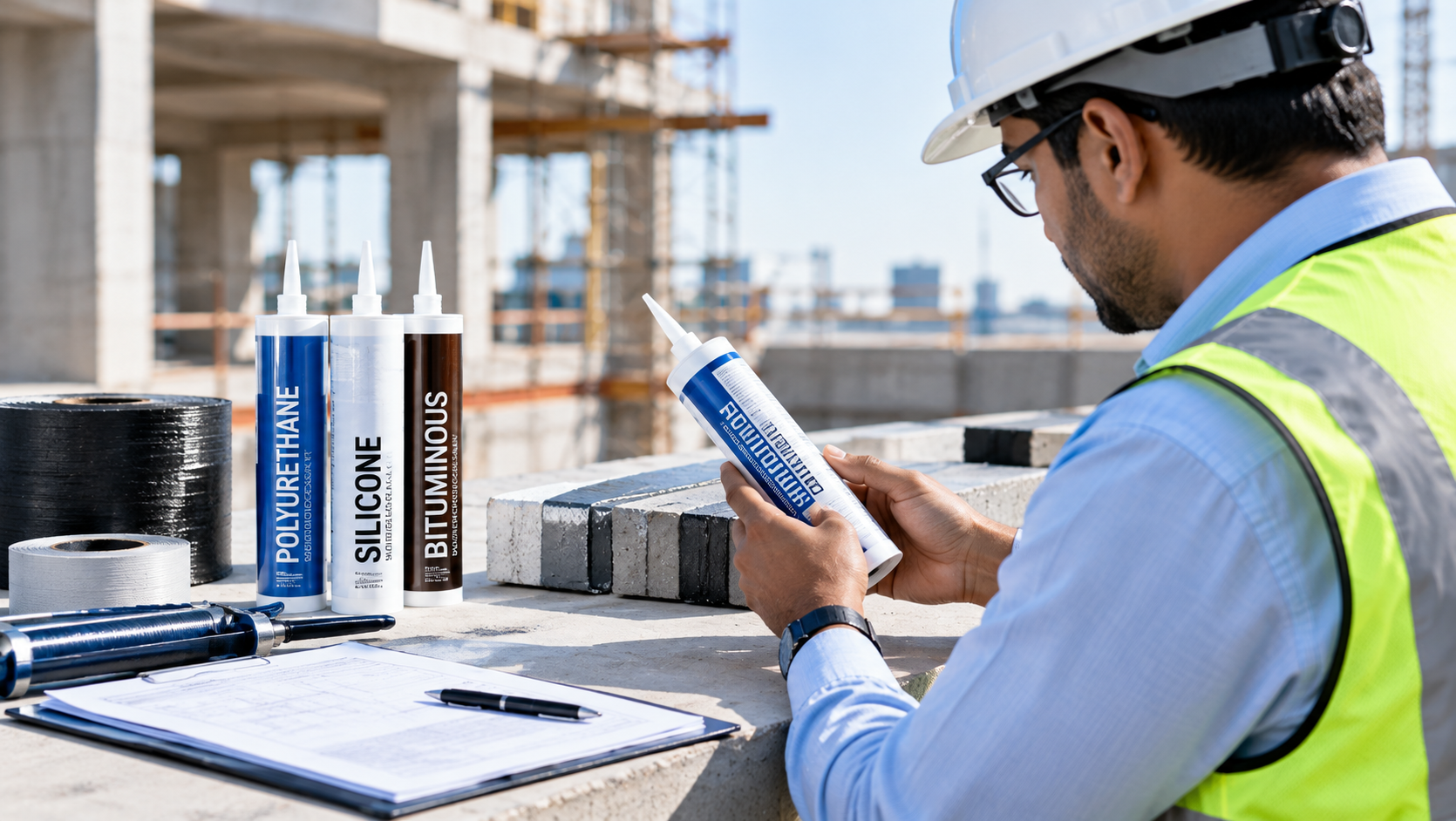
The wrong-product trap
Your supplier recommended "sealant" — but which chemistry?
Each has completely different movement capability, adhesion profile, and temperature range.
- A PU sealant in a high-movement bridge joint will tear.
- A silicone on porous concrete won't adhere.
The supplier who sold it didn't know the difference — because sealants are page 47 of their 200-page catalogue.

The "specialist support" that doesn't exist
You call because the sealant isn't curing on site. The receptionist says:
There is no sealants team — there's one person handling sealants, adhesives, epoxies, and tile grouts, and he's "in a meeting." Your applicator is on scaffolding waiting.
Three days later, still no callback.
Joint sealants need a manufacturer who understands construction chemistry — not a trader who stocks 500 products and specialises in none.
When you buy from a company that primarily makes paints, or a distributor selling everything from plumbing to adhesives, their QC doesn't test sealant-specific properties. Their sales can't recommend the right chemistry. When something fails, nobody can actually help.
Source from a specialist manufacturer of construction sealants and waterproofing products — where sealants are a core product, not an afterthought.

Torchtar Joint Sealants
Construction sealants from a specialist manufacturer with 41 years in waterproofing and sealing.
Polysulphide Sealants
For expansion joints in bridges, flyovers, and buildings
PU (Polyurethane) Sealants
For construction joints, curtain walls, panel joints
Bituminous Joint Sealants
For road and pavement joints — hot-pour and cold-pour
Indian Temperature Extremes
Formulated for Indian temperature extremes — 50°C summers to sub-zero winters
Immediate Dispatch
Immediate dispatch from ready stock — 20 days inventory maintained
Right Chemistry, Every Time
Technical team helps select right chemistry for your specific joint type, substrate, and movement requirement
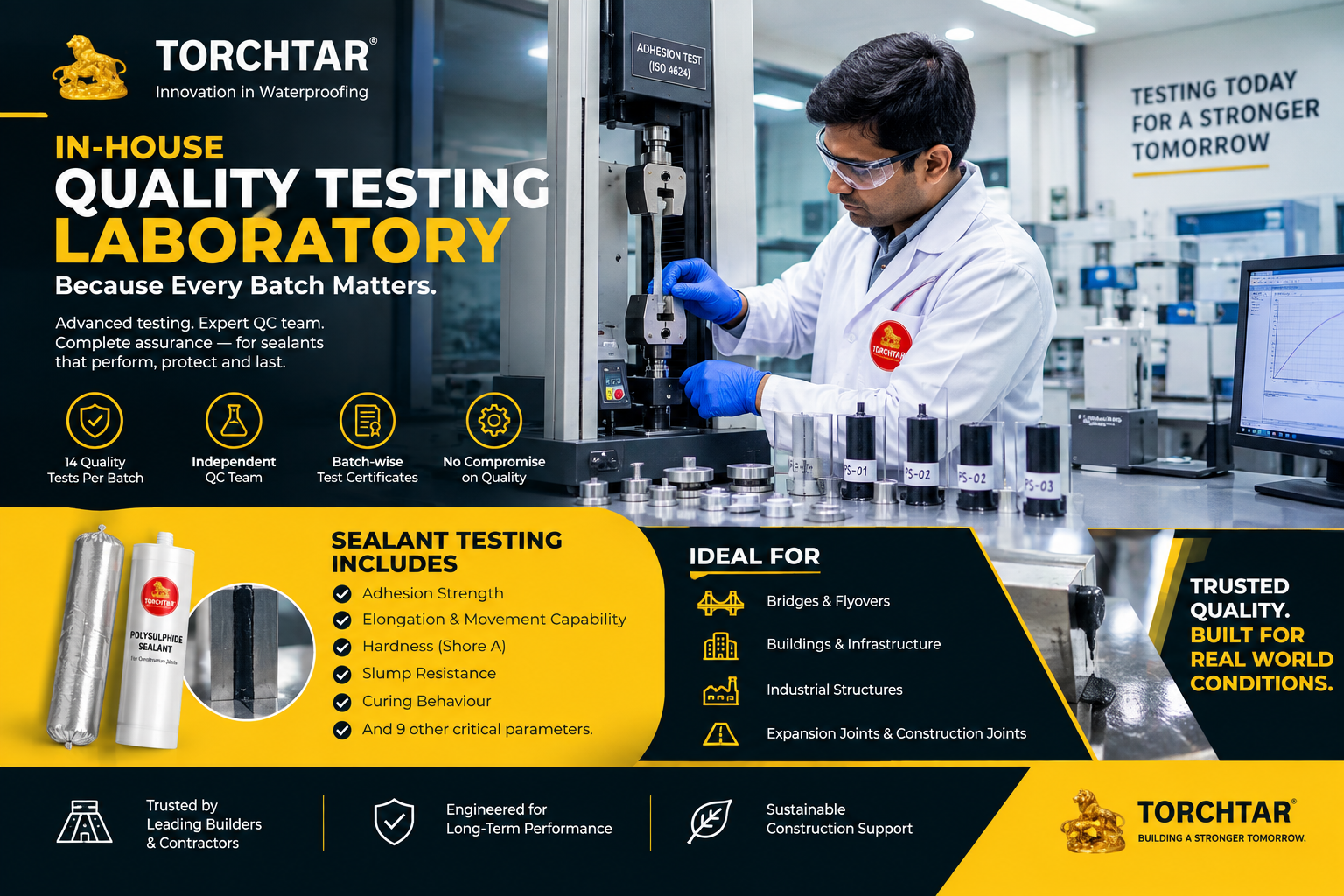
Independent QC sign-off
In-House Quality Lab — Dedicated QC Team
Dedicated QC team tests every sealant batch for:
- 14 tests per batch — independent QC sign-off before dispatch
- Batch-wise test certificates with every delivery — automatically
- If a batch doesn't meet spec, it doesn't ship — no exceptions
Why Torchtar
In waterproofing since 1985
Sealants are core
CAGR vs ~8% industry
Pan-India delivery
Per batch — QC lab
Immediate dispatch
Approvals & Project Track Record
- Sealants supplied for projects by L&T, Tata Projects, JMC Projects, PNC Ltd
- Government approvals: MES, CPWD, PWD, Indian Railways
- OEM manufacturing partner for India's biggest construction-chemical brands
- PSU supply: SAIL, NTPC, NHPC, FCI
- Exported to 8 countries including Australia, Israel
ISO 9001:2015
Certified












Joint Sealant Selection Guide — Which Sealant for Which Joint?
1-page reference chart matching joint types to right chemistry.
Pin it to your site office wall.
Get Expert Joint Sealant Recommendation for Your Project
The right chemistry, the TDS, and a sample from ready stock.